Why Is My Dog or Cat So Itchy? The 3 Big Allergy Triggers
PawMD Veterinary Team
September 22, 2026

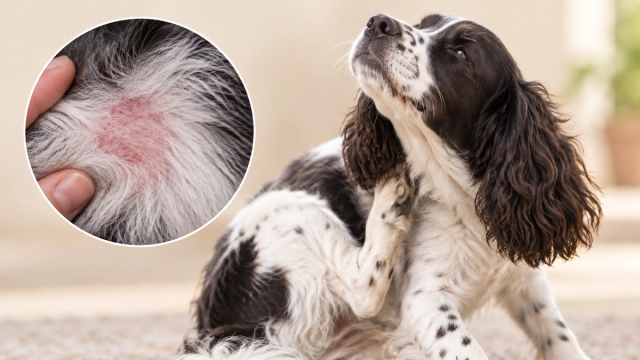
Your dog keeps licking their paws. Their ears smell again. They’re scratching at night, chewing their legs, rubbing their face on the couch, or constantly going after their rear end.
Or maybe your cat seems to be grooming nonstop and suddenly has thin or bald patches of fur.
When pets itch, allergies are often part of the conversation. But “allergies” is a big category, and figuring out what is actually triggering them can get confusing.
A simple way to understand pet allergies is to think about the three arms of the allergy beast:
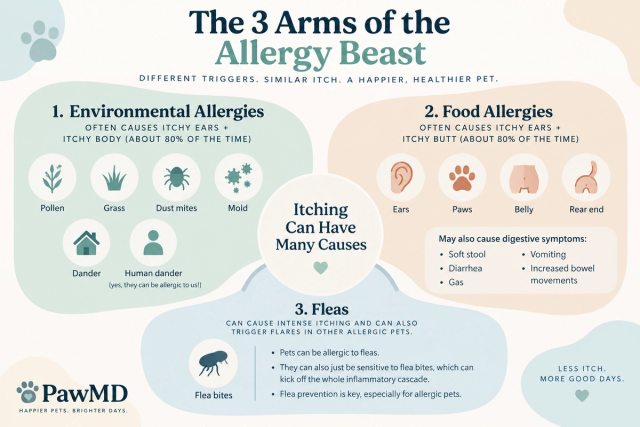
- Environmental allergies
- Food allergies
- Fleas and flea bites
Your pet can have one of them, two of them, or even all three working together.
Meet the Three Arms of the Allergy Beast
Where your pet itches can sometimes give your veterinarian clues about what may be causing the problem.
It is not a perfect diagnostic map. Environmental and food allergies can look extremely similar, and some pets have several allergies at once.
But there are patterns worth knowing.
1. Environmental Allergies: Ears, Paws and Itchy Skin
If your dog has itchy ears along with itching across the paws, face, belly, armpits, or other parts of the body, environmental allergies move higher on the list of possibilities.
Common environmental allergens include:
- Grass
- Tree pollen
- Weed pollen
- Mold
- Dust
- Dust mites
- Dander
- Other particles in the environment
And here is one of the stranger allergy facts:
Your pet can potentially be allergic to human dander, too.
We usually think about people being allergic to dogs and cats, but humans shed microscopic skin particles just like other animals do. Those particles can become environmental allergens for a susceptible pet.
So yes, in some cases, the dog sleeping in your bed may theoretically be allergic to you while you’re allergic to them.
2. Food Allergies: Ears, Skin and Sometimes the Rear End
If a dog has recurring itchy ears along with itching around the rear end, belly, paws, or other areas, food allergy becomes another possibility to investigate.
Some food-allergic pets also develop digestive symptoms such as:
- Soft stool
- Diarrhea
- Increased bowel movements
- Gas
- Vomiting
But food allergies do not always cause stomach problems. Some pets show almost entirely skin and ear symptoms.
The important thing to remember is that the location of the itching gives us clues, not a diagnosis. Itchy ears plus body itching can make environmental allergies suspicious, while ear and rear-end itching can raise suspicion for food allergy. There is enough overlap that you cannot reliably diagnose the cause based only on where your pet scratches.
3. Fleas: The Tiny Trigger That Can Blow Everything Up
The third arm of the allergy beast is fleas.
Some pets are specifically allergic to proteins in flea saliva. For those animals, even a small number of flea bites can cause intense itching, especially around the lower back, tail base, rear legs, and belly.
But fleas can also cause trouble in a pet whose main allergy is something completely different.
Think of your dog’s skin inflammation like a cup that is almost full.
Environmental allergies may fill most of the cup. A food reaction might add a little more. Then a flea bites.
The cup spills over.
For an allergic pet, one extra trigger can be enough to start an entire itch-and-inflammation flare.
The pet scratches. The skin barrier becomes damaged. Yeast and bacteria take advantage of that damaged skin. Now the pet is not only allergic, but may also have a secondary infection making the itching dramatically worse.
That is why consistent flea prevention matters even when fleas are not your pet’s primary allergy.
Why Does My Dog Keep Getting Ear Infections?
Recurring ear infections are one of the biggest clues that an underlying allergy may be involved.
The ear canal is lined with skin. When allergies inflame that skin, the environment inside the ear changes.
Yeast and bacteria that normally exist in small numbers can suddenly multiply.
You may notice:
- Head shaking
- Ear scratching
- Redness
- A strong or musty odor
- Brown, yellow, or dark discharge
- Greasy skin
- Pain when the ear is touched
Treating the infection can make the ear better temporarily.
But if the underlying allergy is still active, the infection may come right back.
If your dog keeps getting ear infections, the bigger question may not be “Why does my dog keep getting infections?” It may be “What keeps inflaming my dog’s ears?”
Why Does an Allergic Pet Start to Smell?
Allergies themselves are only part of the problem.
When a pet scratches, licks, and chews irritated skin, the protective skin barrier becomes damaged. Yeast and bacteria can then overgrow.
That secondary infection can cause:
- A musty or sour odor
- Greasy skin
- Redness
- Darkened skin
- Thickened skin
- Crusts or scabs
- Hair loss
- Even more itching
This creates the classic allergy cycle:
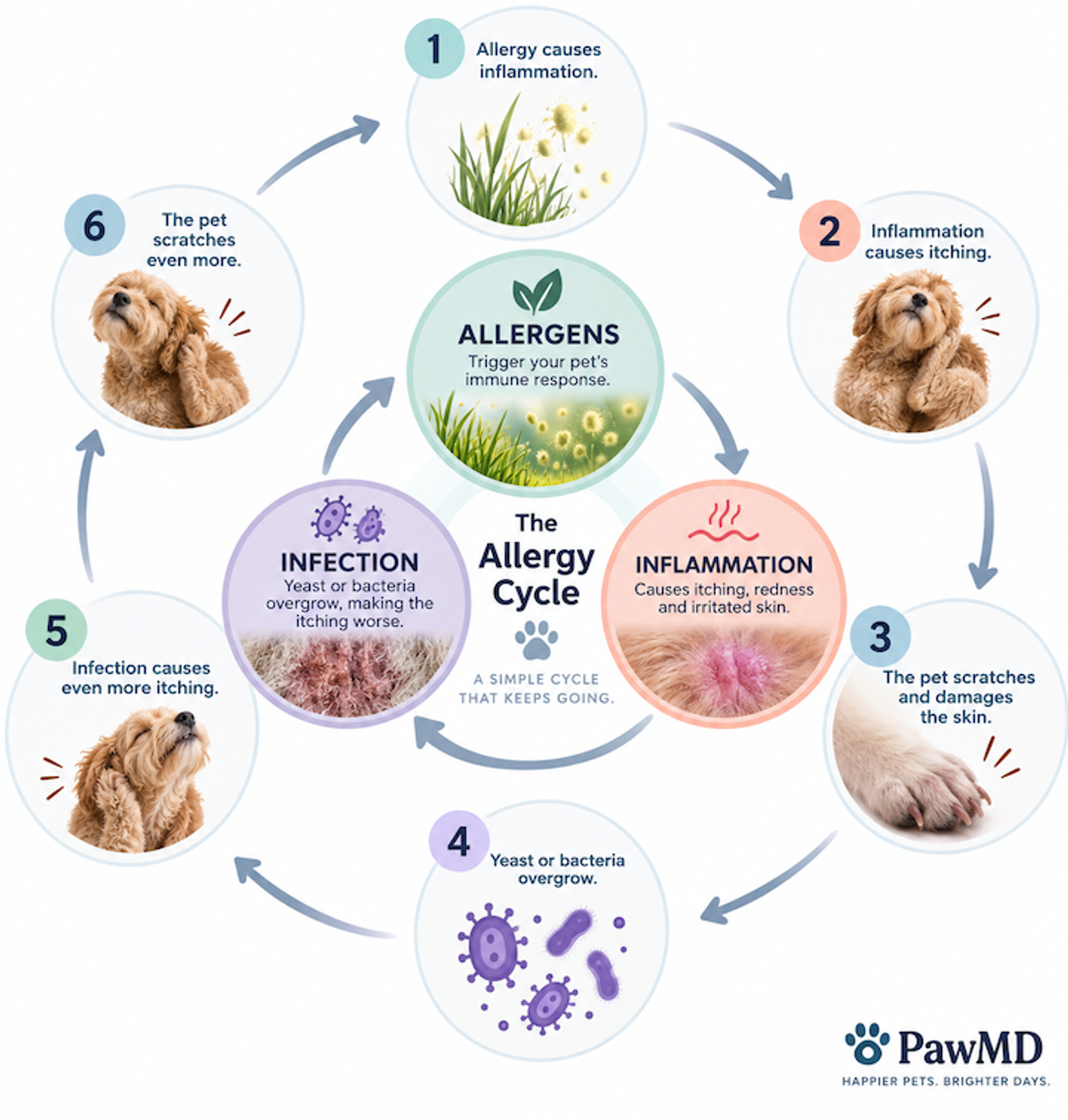
- Allergy causes inflammation.
- Inflammation causes itching.
- The pet scratches and damages the skin.
- Yeast or bacteria overgrow.
- Infection causes even more itching.
- The pet scratches even more.
Getting an allergy flare under control before a secondary infection develops can make long-term management much easier.
Environmental Allergies: Can You Actually Treat the Cause?
This is where environmental allergy treatment gets interesting.
Medications such as Apoquel, Cytopoint, steroids, and other therapies can help control itching and inflammation.
But allergen-specific immunotherapy takes a different approach.
Instead of simply turning down the itch, immunotherapy attempts to change how the immune system reacts to environmental allergens.
How Allergy Shots Work
The idea is similar to allergy shots used in people.
Once your veterinarian has determined that environmental allergies are likely, specialized allergy testing can help identify which environmental allergens your pet reacts to.
Those results can then be used to create a customized mixture containing tiny amounts of relevant allergens.
The pet is exposed to carefully controlled amounts over time, usually through injections or sometimes through treatment given under the tongue.
The goal is essentially to teach the immune system:
“This pollen, dust mite, mold, or dander is not actually dangerous. You don’t need to overreact every time you see it.”
Immunotherapy is different from medications that primarily control the symptoms of allergies because the goal is to change the immune system’s response to the allergens themselves.
But it is not fast.
Improvement can take months, and many pets still need other treatments while immunotherapy begins working.
Doesn’t Allergy Testing Tell Me If My Pet Has Allergies?
Not exactly.
This is one of the most important things for pet parents to understand.
Environmental allergy testing is not usually used to answer the question:
“Does my dog have environmental allergies?”
That diagnosis comes from your pet’s history, symptoms, examination, and ruling out other major causes of itching.
Allergy testing becomes most useful after environmental allergies are already strongly suspected and immunotherapy is being considered.
The testing helps determine what should go into your pet’s customized immunotherapy formula.
What About Food Allergies?
Food allergies require a completely different approach.
There is not a reliable blood, saliva, hair, or skin test that replaces a properly performed food elimination trial.
The most reliable approach is a strict veterinary-guided diet trial.
Why Can’t I Just Buy a “Limited Ingredient” Food?
This is where pet food labels can become misleading.
Imagine a bag that says:
“Salmon recipe. Limited ingredients.”
You might assume salmon is the only animal protein your dog will encounter.
Unfortunately, over-the-counter pet foods are commonly manufactured on equipment that also handles other foods and proteins.
That means traces of chicken, beef, pork, or other proteins may potentially make their way into the food even if those proteins are not intentionally included in the recipe.
For the average dog, that small amount may not matter.
For a dog going through a true food allergy elimination trial, it can ruin the entire experiment.
That is why veterinarians generally use a veterinary prescription hydrolyzed diet, a carefully selected prescription novel-protein diet, or in some situations a properly formulated home-cooked elimination diet.
Regular over-the-counter “limited ingredient” diets are not considered reliable enough for a true diagnostic food trial.
What Is a Hydrolyzed Diet?
Hydrolyzed diets use proteins that have been broken into much smaller pieces.
Think of a protein like a photograph that your pet’s immune system recognizes.
Hydrolysis runs that photograph through a paper shredder.
The pieces may become small enough that the immune system is much less likely to recognize the original protein and react to it.
How Long Does a Food Trial Take?
A proper elimination diet takes weeks, not days.
During the trial, the prescribed diet needs to be the only food exposure unless your veterinarian specifically approves something else.
That means watching out for:
- Treats
- Table scraps
- Flavored medications
- Chews
- Dental treats
- Supplements with flavoring
- Food dropped by children
- Another pet’s food
One small exposure can muddy the results and make it harder to know whether the diet is actually helping.
Why Flea Prevention Matters So Much for Allergic Pets
Even if your pet’s primary problem is environmental or food allergy, flea prevention should remain part of the plan.
A flea bite adds another inflammatory trigger to skin that may already be struggling.
For pets with true flea allergy dermatitis, the reaction can be even more dramatic because they are hypersensitive to flea saliva.
This is why veterinarians often recommend year-round flea control for allergic pets rather than waiting until someone actually sees fleas.
And remember: not seeing fleas does not necessarily mean there are no fleas.
Allergic pets may groom them off quickly, and a small number of bites can still make an allergy flare much worse.
There are both oral and topical flea preventatives available. The right choice depends on your pet, lifestyle, bathing schedule, medical history, other parasites you need protection against, and the specific product.
Some products kill fleas after they begin feeding, while certain products can also have repellent effects. If preventing flea bites is especially important for your allergic pet, ask your veterinarian which product makes the most sense.
So Which Allergy Does My Pet Have?
Unfortunately, allergic skin disease rarely gives us one perfect clue.
Think of your pet’s symptoms as pieces of a puzzle.
Environmental allergies may be suspected when the ears, paws, face, belly, and body repeatedly become itchy.
Food allergy may move higher on the list when itching is year-round, ear disease keeps returning, the rear end is involved, or digestive symptoms occur along with the skin problems.
Fleas move higher on the list when itching is concentrated around the lower back and tail base, but flea exposure can make almost any allergic pet itchier.
And then there are mites, infections, ringworm, and other skin diseases that can imitate allergies.
Pets can also have more than one allergy.
Environmental allergy, food allergy, and flea allergy are not mutually exclusive. Some pets may have two or even all three contributing to their symptoms.
What Does Atopic Dermatitis Look Like in Dogs?
Environmental allergies often show up as behaviors before pet parents ever notice an obvious rash.
Common signs include:
- Paw licking
- Chewing between the toes
- Ear scratching
- Face rubbing
- Belly licking
- Repeated ear infections
- Red skin
- Hair loss
- Musty skin odor
- Darkened or thickened skin over time
Paws and ears are particularly common problem areas.
What Do Allergies Look Like in Cats?
Cats can make allergies harder to recognize.
Instead of obvious scratching, an allergic cat may simply groom constantly.
You may notice:
- Excessive licking
- Bald patches
- Small crusty bumps
- Face or ear scratching
- Red skin
- Sores
- Overgrooming of the belly or legs
Because many different conditions can cause these same patterns in cats, veterinary evaluation is particularly important.
What Can I Do at Home?
You probably cannot create an allergen-free world for your pet.
But you can reduce some of the things that push their immune system over the edge.
- Keep your pet on consistent year-round flea prevention.
- Wash pet bedding regularly.
- Vacuum frequently.
- Bathe your pet with veterinarian-recommended products.
- Clean or rinse paws after heavy outdoor exposure when recommended.
- Watch for the earliest signs of an ear infection.
- Contact your veterinarian before the skin becomes severely inflamed.
- Follow elimination diets exactly when testing for a food allergy.
- Do not repeatedly switch foods at random trying to find the allergy.
When Should I Call a Veterinarian?
Contact your veterinarian if your pet:
- Scratches frequently
- Constantly licks or chews the paws
- Develops bald spots
- Has red, greasy, smelly, or painful skin
- Keeps getting ear infections
- Develops sores, crusts, or scabs
- Wakes up at night to scratch
- Rubs or chews the rear end repeatedly
- Has year-round itching
- Has seasonal itching that returns every year
- Has diarrhea or vomiting along with chronic skin problems
- Suddenly gets much itchier despite previously successful treatment
Sudden facial swelling, widespread hives, collapse, severe vomiting with weakness, or difficulty breathing is different from chronic itchy skin. Those symptoms can indicate a serious allergic reaction and require urgent veterinary care.
The Bottom Line
When your dog or cat will not stop scratching, don’t just think “itchy skin.”
Think about the three arms of the allergy beast:
- Environment
- Food
- Fleas
Then remember that yeast and bacterial infections can pile on top of any of them and make everything worse.
The goal is not simply to stop your pet from scratching for a few days.
The goal is to figure out what keeps triggering the inflammation, control secondary infections, prevent avoidable flare-ups, and build a long-term plan that keeps your pet comfortable.
An itchy pet does not have to stay itchy. The first step is figuring out which part of the allergy beast you are fighting.
Dogs · Cats · Skin & Allergies · Fleas & Ticks · Itching · Ears · Nutrition
Related articles
- Vomiting or Diarrhea in Dogs and Cats: What to Do and When to Worry
First Aid & Emergencies
This article is for general information and is not a substitute for veterinary advice. Contact a veterinarian if your pet is in distress or you are unsure what to do next.