Vomiting or Diarrhea in Dogs and Cats: What to Do and When to Worry
PawMD
September 21, 2026

You wake up to diarrhea on the floor. Your dog suddenly throws up dinner. Your cat vomits twice and then hides under the bed.
Sometimes vomiting or diarrhea is a short-lived stomach upset. Other times, it is the first sign of poisoning, an intestinal blockage, infection, or another problem that needs veterinary care.
The difficult part for pet parents is knowing the difference.
Here is what to look for, what you can safely do at home, and when you should stop watching and call a veterinarian.
First, how is your pet acting?
This matters just as much as the vomiting or diarrhea itself.
A dog who has one loose stool but is still eating, drinking, playing, and acting completely normal is very different from a dog who has diarrhea and is lying in the corner, refusing food, or acting painful.
The same applies to cats. Cats are especially good at hiding illness, so changes in behavior, appetite, energy, or hiding can be important clues.
If your pet seems genuinely sick in addition to vomiting or diarrhea, contact a veterinarian rather than focusing only on how many episodes have occurred.
When vomiting or diarrhea is an emergency
Do not wait at home if your pet has serious warning signs.
Seek urgent or emergency veterinary care if your pet has:
- Repeated or uncontrollable vomiting
- Blood in the vomit
- Large amounts of blood in the diarrhea
- Black, tar-like stool
- A swollen, hard, or painful abdomen
- Repeated attempts to vomit but little or nothing comes up
- Trouble breathing
- Collapse, severe weakness, or difficulty standing
- Pale, white, blue, or purple gums
- Severe pain
- Tremors or seizures
- Suspected poisoning
- Swallowed a toy, sock, bone, corn cob, string, or another object
- Vomiting or diarrhea along with rapidly worsening behavior
Repeated unproductive retching with a swollen abdomen can be especially concerning for bloat, which can become life-threatening quickly. Severe or prolonged vomiting and bloody or black diarrhea are also considered emergency warning signs.
When in doubt, call a veterinarian and describe exactly what you are seeing.
What should you do after one episode of vomiting?
If your dog vomits once but otherwise seems completely normal, you may be able to monitor them closely.
Do not immediately give another full meal.
Give the stomach some time to settle. Fresh water should generally remain available, because vomiting can lead to dehydration. If drinking a large amount of water at once triggers more vomiting, contact your veterinarian for advice about offering smaller amounts more frequently rather than simply withholding water for hours.
For an otherwise healthy adult dog with an isolated vomiting episode, a veterinarian may recommend temporarily withholding food and then restarting with small amounts of an easily digestible diet.
Cats, puppies, kittens, very small dogs, senior pets, and animals with diabetes, kidney disease, or other medical conditions deserve more caution. Do not use prolonged fasting as a one-size-fits-all treatment.
If vomiting happens again, your pet cannot keep water down, or their behavior changes, contact a veterinarian.
What if it is diarrhea but no vomiting?
One loose stool does not automatically mean your pet is seriously ill.
Dogs sometimes develop diarrhea after eating something unusual, getting into garbage, experiencing stress, or having a sudden diet change.
If your adult pet has mild diarrhea but is otherwise bright, comfortable, eating, drinking, and behaving normally, close monitoring may be reasonable.
Make sure water is available and pay attention to what happens next.
Diarrhea causes the body to lose water, and adding vomiting can accelerate that fluid loss. Persistent diarrhea, particularly when accompanied by poor appetite, lethargy, black stool, or vomiting, should be evaluated by a veterinarian.
Vomiting and diarrhea together deserve more attention
When both are happening, dehydration can develop much faster.
Your pet is losing fluid from both ends while potentially drinking and eating less than normal.
This matters even more in puppies, kittens, senior pets, small animals, and pets with existing medical conditions.
Watch your pet, not just the mess on the floor.
A pet becoming increasingly tired, weak, withdrawn, painful, or uninterested in food or water is more concerning than an otherwise normal pet with one isolated episode.
How can you tell if your pet may be dehydrated?
Vomiting and diarrhea can cause significant fluid and electrolyte loss.
Pet parents may notice dry or tacky gums, unusual tiredness, weakness, reduced appetite, or sunken-looking eyes when dehydration becomes more significant. Cats may show similar changes.
Trying to judge dehydration at home is imperfect, especially when a pet has thick fur or other health problems.
If your pet is repeatedly vomiting, cannot keep water down, or seems weak, do not wait for obvious dehydration before seeking help.
Severely dehydrated pets may need fluids given by a veterinarian, sometimes through an IV.
What NOT to give your pet
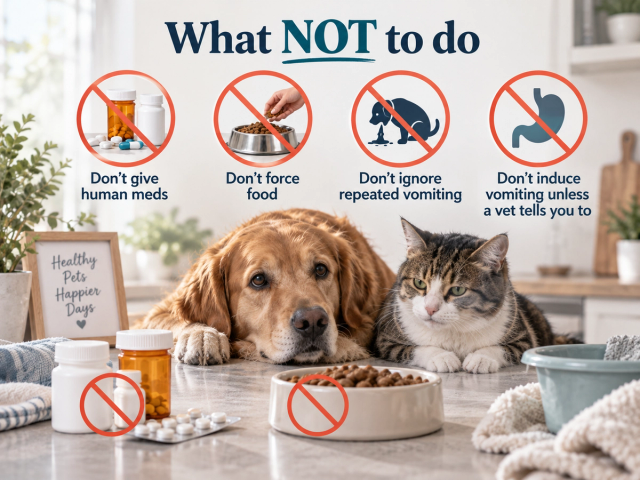
One of the biggest mistakes pet parents can make is reaching into the human medicine cabinet.
Do not automatically give Pepto-Bismol, Imodium, ibuprofen, aspirin, antibiotics, nausea medication, or leftover prescriptions because your pet has an upset stomach.
Some human medications can be dangerous to pets. Others can make certain illnesses worse, interfere with other medications, or hide symptoms your veterinarian needs to evaluate.
Cats are particularly sensitive to several medications that humans commonly use.
If you want to give your pet anything other than their normal food or water, ask a veterinarian first.
Could your pet have eaten something they shouldn't?
This is one of the most important questions to ask.
Think about the last several hours.
Did your dog get into the trash? Could a toy be missing? Did someone leave medication on the counter? Was there chocolate, sugar-free gum, grapes, cannabis, cleaners, rat poison, mushrooms, or another potentially harmful substance nearby?
Vomiting and diarrhea can be signs of poisoning.
If you suspect your pet ate something toxic, do not wait for symptoms to get worse. Call a veterinarian or animal poison-control service promptly.
Do not make your pet vomit unless a veterinarian or poison expert specifically tells you to. Some substances can cause additional damage when they come back up.
Keep a sick pet away from other pets
Vomiting and diarrhea have many possible causes, and some infectious causes can spread between animals.
Until you know what is happening, it is reasonable to separate a sick pet from other animals in the household when possible.
Use separate food and water bowls, clean accidents promptly, wash your hands afterward, and prevent other pets from investigating vomit or stool.
This is particularly important in homes with puppies, kittens, unvaccinated animals, or pets with weakened immune systems.
What information should you give the veterinarian?
The more specific you can be, the easier it is to assess what may be happening.
Be ready to explain when the symptoms started, how many times your pet has vomited or had diarrhea, whether there is blood, whether your pet is eating and drinking, and whether their behavior has changed.
Take a photo of abnormal vomit or stool if possible. It may seem unpleasant, but it can be genuinely useful.
Also mention anything unusual your pet may have eaten and any medications or supplements they currently take.
What might the veterinarian do?
Treatment depends on the cause and severity.
Your veterinarian may start with a physical examination and check your pet's hydration, temperature, abdominal comfort, and overall condition.
Depending on what they find, they may recommend blood tests, stool testing, X-rays, ultrasound, fluids, anti-nausea medication, or other treatment.
If there is concern that your pet swallowed an object, imaging can be especially important. Persistent vomiting can sometimes signal an obstruction that cannot be fixed with a bland diet and time.
The bottom line
One episode of vomiting or diarrhea in an otherwise normal adult pet is not always an emergency.
What happens next matters.
Pay attention to your pet's energy, appetite, ability to drink, abdominal comfort, and whether the vomiting or diarrhea continues.
If your pet becomes weak, painful, refuses food or water, cannot keep water down, has blood in the vomit or stool, develops a swollen abdomen, may have eaten something toxic, or simply looks seriously unwell, contact a veterinarian.
When your pet is sick, the goal is not to see how long you can manage the problem at home. The goal is to recognize when a minor stomach upset is becoming something more serious.
Cats · Dehydration · Digestive · Dogs · Vomiting · Diarrhea · Emergency
Related articles
- Why Is My Dog or Cat So Itchy? The 3 Big Allergy Triggers
Symptoms & Health Conditions
This article is for general information and is not a substitute for veterinary advice. Contact a veterinarian if your pet is in distress or you are unsure what to do next.